Serpent Lights in the Night: Mar’s Enigmatic Aurora
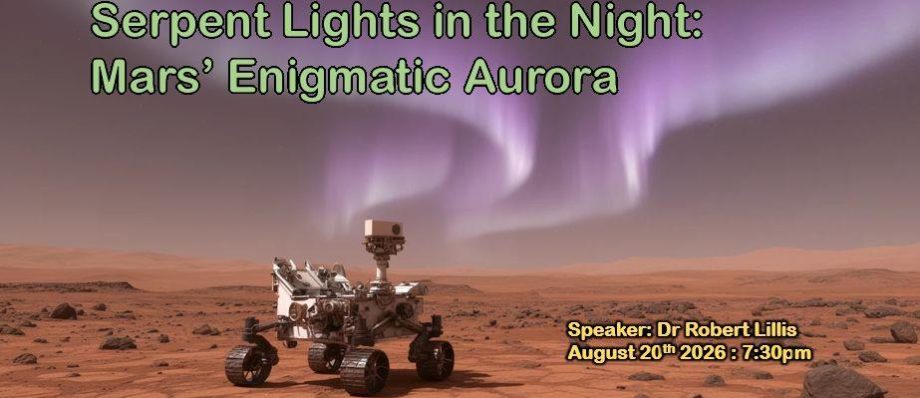
Auroras on Mars provide a dramatic view into how the planet’s atmosphere interacts with the solar wind, offering key insights into its magnetic and atmospheric behavior.Unlike Earth, Mars lacks a global magnetic field, resulting in three distinct types of aurora: *diffuse aurora*, seen across much of the nightside during intense solar storms; *electron aurora* (often called discrete aurora), which is confined to regions with strong crustal magnetic fields; and *proton aurora*, caused by incoming solar wind protons interacting with the upper atmosphere. NASA’s MAVEN spacecraft has been instrumental in discovering and studying these auroras, particularly through its ultraviolet and particle instruments.The Emirates Mars Mission has complemented this work by providing wide-field, global observations of auroral activity, helping to track how it evolves over time and space. In a major recent development, NASA’s Perseverance rover made the first observations of *visible light aurora* from the Martian surface during a solar energetic particle event—marking a new chapter in auroral studies on Mars. These combined observations are deepening our understanding of how Mars responds to solar activity, especially in the absence of a protective magnetic field. As we learn more, Martian aurora offer both a spectacular natural phenomenon and a powerful probe of planetary space weather.
ABOUT THE SPEAKER: Dr. Robert Lillis
Dr. Robert J. Lillis is a planetary space physicist and geophysicist at the University of California, Berkeley’s Space Sciences Laboratory, where he serves as Associate Director of the Planetary Group. His research focuses on Mars, exploring topics such as atmospheric escape, crustal magnetism, ionospheric electrodynamics, and solar energetic particles.
Lillis is the Principal Investigator for NASA’s ESCAPADE mission, a twin-spacecraft endeavor aimed at studying Mars’ magnetosphere and its interactions with the solar wind . He also contributes to the MAVEN and Emirates Mars missions, enhancing our understanding of Martian upper atmospheric and magnetospheric dynamics.
He earned his BA in Theoretical Physics from Trinity College Dublin and completed his PhD in Physics at UC Berkeley.
This meeting is also available via Zoom